Repair or Replace? The Appliance Age Guide Every Homeowner Needs Before Calling a Technician
 Elizabeth KiselevMarch 31, 20268 min read
The technician is standing in your kitchen. Your dishwasher stopped mid-cycle, there's water on the floor, and you need to make a decision fast. Repair it, or replace it?
It's one of the most common questions homeowners face, and most people answer it wrong. They either spend $500 repairing an appliance that breaks again six months later, or they replace something that had years of life left in it.
There's a better way to make this decision. It takes about two minutes, requires knowing two numbers, and it works for every major appliance in your home.
The Rule of 50%: The Only Framework You Need
The Rule of 50% is the standard guideline used by appliance repair professionals across the industry. It works like this: if a repair costs more than 50% of what a comparable new appliance would cost, replace it. If the repair costs less than 50%, fix it.
But the more accurate version, the one that saves the most money, is actually a two-condition test known as the 50/50 Rule:
Condition 1: The appliance has used up more than 50% of its expected lifespan.
Condition 2: The repair cost exceeds 50% of the price of a new, comparable model.
Both conditions must be true before replacement is clearly the right call. [1]
The 50/50 Rule in Action
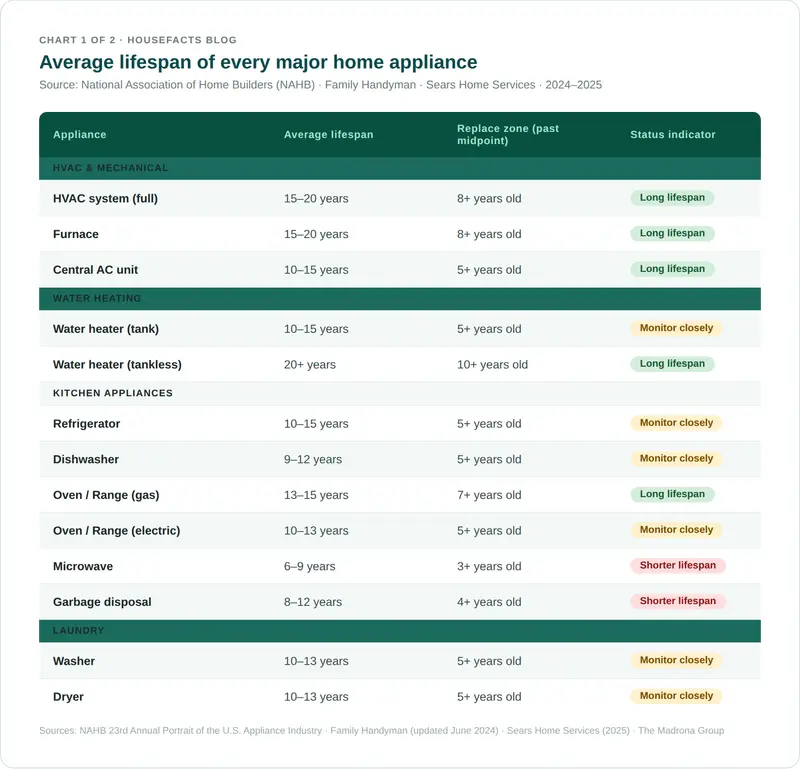
Your washing machine is 9 years old. Average lifespan: 10–13 years. It has used roughly 75% of its expected life: Condition 1 is met.
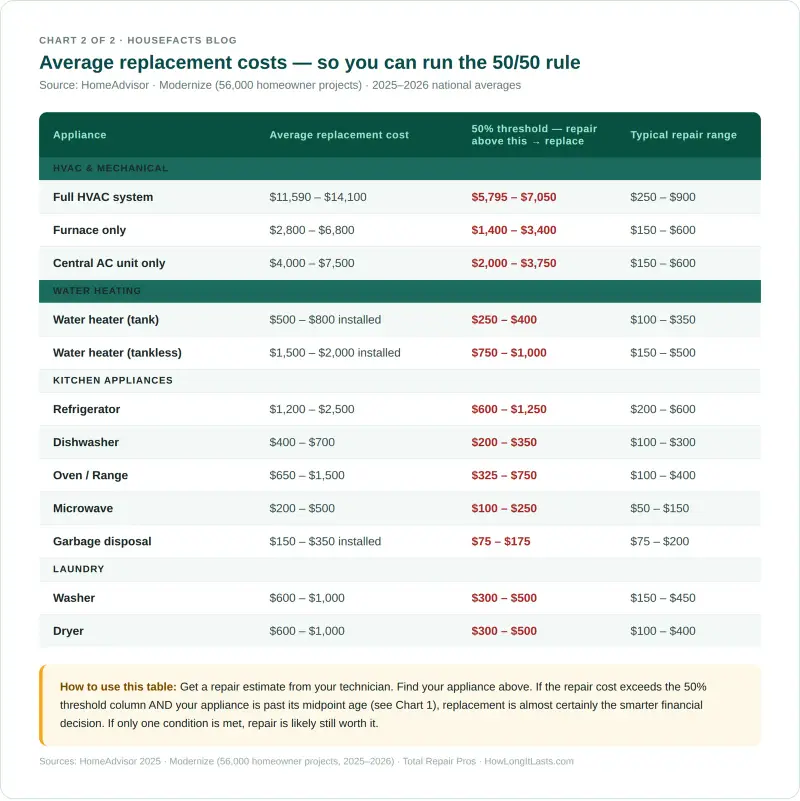
The repair estimate is $380. A comparable new washer costs $700. The repair is 54% of replacement cost: Condition 2 is met.
Both conditions are true. Replace it.
Now flip the scenario: the same machine is only 4 years old. It has used roughly 35% of its expected life: Condition 1 is not met. Even if the repair is expensive, fixing it is almost certainly the right call. You are repairing a relatively new machine with most of its life still ahead of it.
Why Age Matters As Much As Repair Cost
The repair cost alone doesn't tell the full story. An appliance that has surpassed its midpoint is aging as a system, not just as individual parts. When one major component fails due to wear, heat, or mechanical stress, others are likely not far behind. [2]
Spending $500 to repair a 12-year-old refrigerator does not give you a $500 refrigerator. It gives you a 12-year-old refrigerator with one fixed component and several others that are equally aged. The repair recovers none of its cost if something else fails next year.
This is precisely why knowing your appliance's age (and comparing it to its expected lifespan) is the most important number in the decision.
Average Lifespan of Every Major Home Appliance
The following lifespan data is drawn from the National Association of Home Builders (NAHB) and corroborated by industry sources including Family Handyman, Sears Home Services, and appliance repair professionals. [3][4][5] For the full breakdown by appliance type, see how long home appliances typically last.
Average Replacement Costs: So You Can Run the Math
To apply the 50/50 Rule, you need to know what a new appliance actually costs. The 50% threshold column does the math for you: if your repair quote exceeds that number and your appliance is past its midpoint, replacement is the smarter call. [6][7]
Four Situations Where the Rule of 50% Doesn't Apply
The Rule of 50% is a starting point, not a law. There are specific situations where it should be overridden:
1. The appliance is still under warranty.
If any portion of the manufacturer's or extended warranty is still active, the repair decision changes entirely. Covered repairs, even major ones, are almost always the right call because your cost is zero or minimal. Always check warranty status before calling a technician. [8]
2. The appliance is a premium brand.
Standard lifespans and replacement costs apply to mid-range appliances. Sub-Zero, Wolf, Miele, and similar premium brands are built to last 20 years or more, with modular components designed to be serviced indefinitely. A $600 repair on a 10-year-old Sub-Zero refrigerator may be completely justified because the appliance could run another decade. [2]
3. Supply chain delays make replacement impractical.
If you need a working washer or dishwasher immediately and replacement means a 3-week wait, paying slightly over the 50% threshold to repair today can be a valid short-term decision. Time has real value, especially in a busy household.
4. The repair is minor and isolated.
Not all repairs indicate systemic aging. A broken door seal, a faulty igniter, or a clogged drain pump are isolated fixes that don't suggest the rest of the appliance is deteriorating. If the repair is under $200 and the failure is clearly isolated, repair is almost always the right choice, regardless of age. [8]
The Most Expensive Mistakes Homeowners Make
Repairing a compressor on an old refrigerator.
A compressor replacement on a 12-year-old refrigerator can cost $500 or more. On an appliance that has exceeded its average lifespan, this is the single most common expensive mistake homeowners make: investing heavily in a machine that may not survive another major failure.
Replacing an appliance that's still under warranty.
Every year, homeowners pay out of pocket for repairs that manufacturer warranties would have covered, because they never checked before calling a technician.
Not knowing the appliance's age.
The entire 50/50 framework collapses without knowing how old the appliance is. Most homeowners can't answer this accurately, especially for appliances inherited from a previous owner. The manufacture date is encoded in the serial number on every major appliance. Finding it takes about 60 seconds and changes every repair decision you'll make.
How to Find Your Appliance's Age From the Serial Number
Every major appliance encodes its manufacture date in the serial number. The location varies by brand, but the serial number is always on a sticker or plate, usually inside the door, on the back panel, or underneath the unit. Search "[your appliance brand] serial number date decoder" and you can find the exact manufacture month and year in under a minute.
HouseFacts decodes the serial number and keeps every appliance's age on record, so you always know where every appliance stands relative to its expected lifespan.
The System That Makes This Easy
The 50/50 Rule is simple in theory. In practice, it requires knowing three things for every appliance in your home: how old it is, what it would cost to replace, and what repair quotes are coming in at.
Most homeowners don't have the first number. They don't know how old their water heater is, when the HVAC was last replaced, or what year the dishwasher was installed. When something breaks, they're making a thousand-dollar decision based on guesswork.
HouseFacts fixes this. Every appliance you log (age, model, purchase date, service history) lives in one place, organized by room. When a technician shows up and quotes you $600 to fix your washing machine, you can pull up the exact age and model in 10 seconds, run the 50/50 Rule on the spot, and make a confident decision. No guessing. No overpaying.
DISCLAIMERThis article is for general informational purposes only. Appliance lifespans vary by brand, model, usage, and maintenance. Always consult a qualified appliance technician before making repair or replacement decisions. Cost estimates reflect national averages and may vary significantly by region.
SOURCES
[1] Total Repair Pros. "The 50/50 Rule for Appliance Repair vs. Replacement." January 2026. https://totalrepairpros.com/appliance-50-50-rule/
[2] HowLongItLasts. "The Appliance 50% Rule Explained: Repair vs Replace Decisions." December 2025. https://howlongitlasts.com/the-appliance-50-rule-explained/
[3] The Madrona Group. "How Long Do Appliances Last? A Homeowner's Guide." https://www.themadronagroup.com/how-long-do-appliances-last/
[4] Family Handyman. "Average Life Span of the Appliances in Your Home." Updated June 2024. https://www.familyhandyman.com/article/home-appliances-lifespan/
[5] Sears Home Services. "How Long Do Major Appliances Last?" September 2025. https://www.searshomeservices.com/blog/how-long-do-appliances-usually-last
[6] HomeAdvisor. "How Much Does HVAC Installation or Replacement Cost?" 2025. https://www.homeadvisor.com/cost/heating-and-cooling/
[7] Modernize. "New HVAC System Cost Calculator." Based on 56,000 real homeowner projects, 2025–2026. https://modernize.com/hvac/cost-calculator
[8] House Digest. "The 50% Rule That'll Help You Determine If It's Time To Replace Your Kitchen Appliances." November 2025. https://www.housedigest.com/2022441/50-percent-rule-determine-replace-repair-kitchen-appliances/
Keep reading
 appliancesmaintenance
Your Water Heater Might Fail. Whether Insurance Pays for the Damage Comes Down to a Few Words in Your Policy.
Does homeowners insurance cover water heater leaks? Usually yes if the failure is sudden, no if it's gradual. Here's how to protect your claim before it happens.
 appliancesseasonal
The Things That Live Outside: A Guide to Outdoor Appliance Safety
Keep your grill, generator, and outdoor appliances safe year-round. Practical tips on fuel, electrical safety, and off-season storage for homeowners.
 maintenance
HVAC Maintenance Checklist: What to Log at Every Service Visit
An HVAC maintenance checklist built for record-keeping: the date, tech, parts, and cost to log at every visit so it holds up for a warranty or insurance claim.