Your HVAC Replacement Built Your Cost Basis. Your Forgotten Receipt Just Destroyed It.
 Elizabeth KiselevMarch 30, 20269 min read
Let's say you replaced your HVAC system three years ago. The job cost you $11,500, in line with typical costs. You remember signing the invoice, handing over the check, and feeling the relief of cool air running through your house again.
Then you moved on. Life happened. The invoice went into a drawer. The drawer got cleaned out. The receipt is gone.
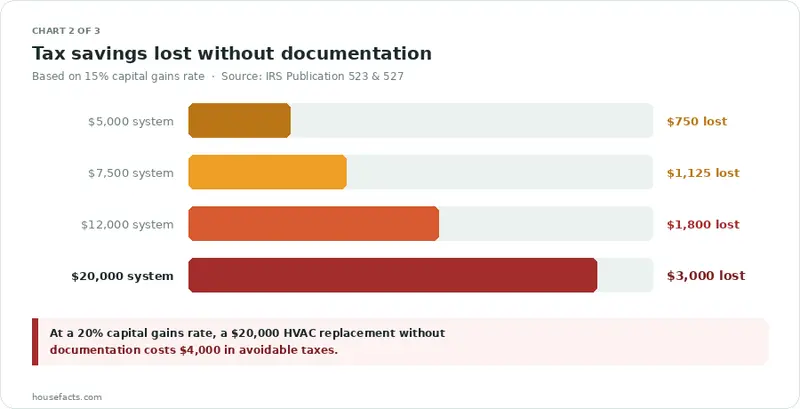
When you sell your home next year, that $11,500 disappears too. Not just from your files. From your tax return. You will pay capital gains on money the IRS would have let you shield, if only you had a single piece of paper to back it up.
This is the most common and most preventable tax mistake homeowners make. Here's exactly why it happens, what it costs you, and how to make sure it never happens to you.
What Is Adjusted Cost Basis, And Why Does It Matter?
Your cost basis is what you paid for your home, plus every qualifying improvement you've made since you bought it. When you sell, the IRS taxes you on the difference between your sale price and your adjusted cost basis, not your original purchase price.
The higher your documented cost basis, the less of your sale profit is subject to capital gains tax. Every dollar of qualifying improvement you can prove is a dollar that doesn't get taxed.
Why HVAC Replacement Specifically Qualifies
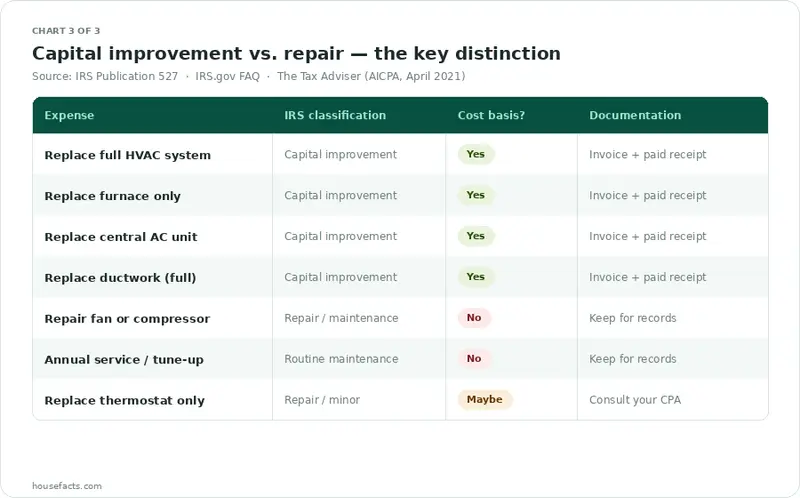
Not every home expense qualifies as a capital improvement. The IRS draws a sharp line between repairs (which do not increase your cost basis) and capital improvements (which do).
According to IRS Publication 523 (Selling Your Home) and Internal Revenue Code Section 263(a), a capital improvement must meet at least one of three criteria, sometimes called the BAR test:
- Betterment: Materially increases the property's capacity, productivity, or quality
- Adaptation: Converts the property to a new or different use
- Restoration: Returns the property to operating condition after deterioration, or replaces a major component
Replacing an entire HVAC system (the furnace, air conditioner, or the full combined system) clearly qualifies under Restoration. The IRS specifically identifies heating and air conditioning systems as one of eight building systems subject to these rules, and replacing a central air system is explicitly listed as an example of a capital improvement in IRS Publication 523. [2]
The Numbers: What a Typical HVAC Replacement Is Worth at Tax Time
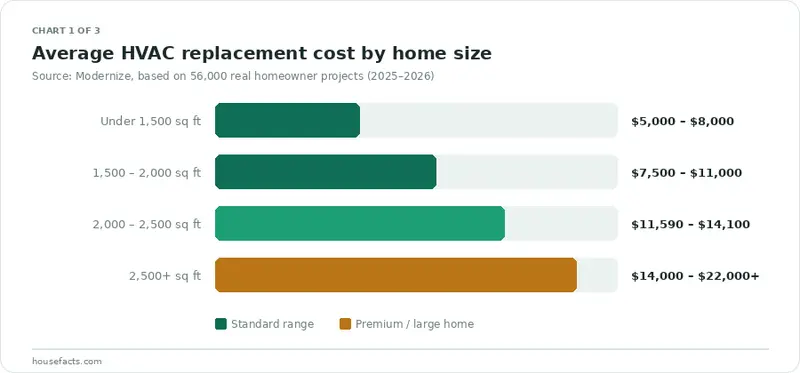
Based on data from 56,000 real homeowner projects tracked by Modernize, the average HVAC system replacement in the U.S. currently costs between $11,590 and $14,100 for a standard home. [4] For a 2,000–2,500 square foot home, the typical cost lands around $13,430 for a combined heating and cooling system.
According to HomeAdvisor, most homeowners pay between $5,000 and $12,500, with a national average around $7,500. [5] At the higher end (homes needing ductwork replacement or premium efficiency systems), total costs can reach $20,000 or more.
What Happens If You Can't Find the Receipt?
This is the question nobody wants to ask, because they already know the answer isn't good.
If the IRS audits your home sale and you cannot produce documentation for a capital improvement, they will not accept your word for it. The cost basis adjustment disappears. You pay taxes on gains you shouldn't have to pay.
Tax attorney and Nolo contributor Stephen Fishman, J.D., confirms: "The records homeowners most often lose are those for improvements." His guidance is stark: without documentation, you cannot prove the adjustment, and the IRS will not grant it. [1]
There are some partial remedies if receipts are lost. A tax professional at Ask Liz Weston recommends creating a detailed list from memory with approximate dates and costs, backed by supporting evidence like building permits, before-and-after photos, or insurance policy updates that reflect the higher replacement value. [7] These work as secondary evidence, but they are a last resort, not a strategy.
The $500,000 Exclusion Won't Always Save You
Many homeowners assume the primary residence capital gains exclusion ($250,000 for single filers, $500,000 for married couples filing jointly) makes all of this irrelevant. If their gain is under the exclusion limit, why does cost basis matter?
It matters for three reasons:
- Home values have risen dramatically. In many U.S. markets, homes purchased 10–15 years ago have appreciated well beyond the exclusion limits. A couple who paid $300,000 in 2010 and sells for $950,000 today has a $650,000 gain, $150,000 of which is taxable, and every documented improvement reduces it.
- The exclusion hasn't changed since 1997. The $250,000/$500,000 limits were set nearly three decades ago. As TurboTax notes, home sale profits are no longer automatically tax-free for most owners in appreciating markets. [9]
- You may not qualify for the full exclusion. If you haven't lived in the home for 2 of the last 5 years, or if you've taken depreciation deductions on a home office or rental portion, your exclusion is reduced or eliminated.
What Exactly You Need to Keep
For every capital improvement (HVAC replacement, roof, kitchen remodel, new windows, additions), the IRS expects you to have:
- The original invoice or contract showing the scope of work, contractor name, and total cost
- Proof of payment: a cancelled check, bank statement, credit card statement, or receipt marked paid
- The date of completion: when the improvement was placed in service
- Permit documentation if the work required one: building permits are strong third-party evidence and often held by municipalities for decades
- Before-and-after photos: not required, but valuable supporting evidence and increasingly easy to maintain digitally
Rocket Mortgage and Jackson Hewitt both recommend maintaining both paper and digital copies, and building a dedicated home improvement folder (physical or digital) that travels with the home. [10][11]
The System Most Homeowners Don't Have
The documentation requirement isn't complicated. What's complicated is remembering to do it every single time, for every qualifying expense, across years or decades of homeownership. A kitchen remodel today. An HVAC replacement in three years. A roof in eight. New windows in twelve.
Most homeowners don't have a system. They have a drawer. And when the drawer gets cleared out, the tax protection goes with it. Building one doesn't have to be complicated; see our tips for keeping home expenses organized as you go.
This is exactly the problem HouseFacts was built to solve. Every time you forward or upload a receipt, invoice, or contractor estimate to HouseFacts, it's filed by vendor, service type, and date, and stored securely for as long as you own the property. When you sell, your complete home improvement history is ready to hand to your accountant or tax professional in minutes, not weeks.
DISCLAIMER This article is for general informational purposes only and does not constitute tax, legal, or financial advice. Tax laws are subject to change, and individual circumstances vary. Always consult a qualified CPA or tax professional before making decisions about your home's cost basis or capital gains reporting.
SOURCES
[1] Fishman, S., J.D. "Tax Reasons to Keep Good Records of Home Improvements." Nolo Legal Encyclopedia, updated May 2025. https://www.nolo.com/legal-encyclopedia/tax-reasons-keep-good-records-home-improvements.html
[2] Internal Revenue Service. IRS Publication 523: Selling Your Home. https://www.irs.gov/publications/p523
[4] Modernize. "New HVAC System Cost Calculator: Get a Custom Estimate in 2026." Based on 56,000 real homeowner projects, 2025–2026. https://modernize.com/hvac/cost-calculator
[5] HomeAdvisor. "How Much Does HVAC Installation or Replacement Cost?" 2025 Data. https://www.homeadvisor.com/cost/heating-and-cooling/
[7] Weston, L. "When Receipts of Home Renovations Are Lost, Is the Tax Break Gone Too?" Ask Liz Weston, January 2025. https://asklizweston.com/qa-when-receipts-of-home-renovations-are-lost-is-the-tax-break-gone-too/
[9] TurboTax. "Home Improvements and Your Taxes." Intuit, 2025. https://turbotax.intuit.com/tax-tips/home-ownership/home-improvements-and-your-taxes/L6IwHGrx6
[10] Rocket Mortgage. "Capital Improvements: When Are Home Renovations Tax Deductible?" July 2025. https://www.rocketmortgage.com/learn/capital-improvement
[11] Jackson Hewitt. "Home Improvement Tax Deductions 2025." Accessed 2026. https://www.jacksonhewitt.com/tax-help/tax-tips-topics/real-estate/home-improvement-tax-deductions/
Keep reading
 appliancesmaintenance
Your Water Heater Might Fail. Whether Insurance Pays for the Damage Comes Down to a Few Words in Your Policy.
Does homeowners insurance cover water heater leaks? Usually yes if the failure is sudden, no if it's gradual. Here's how to protect your claim before it happens.
 appliancesseasonal
The Things That Live Outside: A Guide to Outdoor Appliance Safety
Keep your grill, generator, and outdoor appliances safe year-round. Practical tips on fuel, electrical safety, and off-season storage for homeowners.
 maintenance
Repair or Replace? The Appliance Age Guide Every Homeowner Needs Before Calling a Technician
Before you spend $400 on a repair call, spend two minutes with this guide. Knowing your appliance's age, and the Rule of 50%, could save you thousands.